
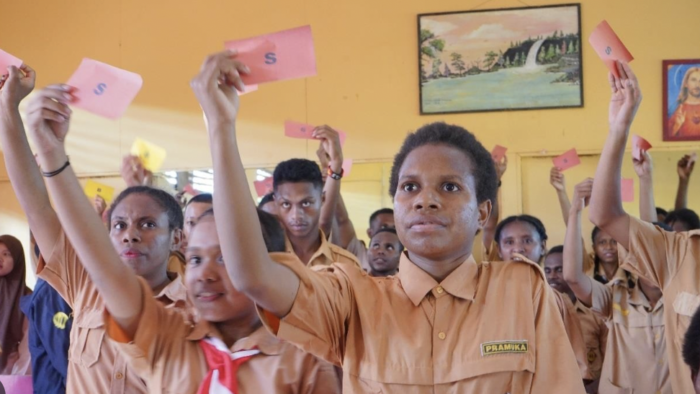
Sorong, Southwest Papua – The Sorong City Government has allocated IDR 17 billion (approx. USD 1.1 million) to strengthen its free education program, reinforcing Indonesia’s long-term commitment to inclusive human development in Papua. The initiative has been positively received by local communities, particularly Indigenous Papuans (Orang Asli Papua/OAP), who see education as a key pathway toward social mobility and equal opportunity.
Mayor of Sorong Septinus Lobat emphasized that free education is not merely a policy statement, but a concrete action to ensure that Papuan children—especially Indigenous Papuans—have equal access to quality schooling.
“Indonesia’s Vision 2045 cannot be achieved without Papua moving forward together. Indigenous Papuans must be at the center of this progress. Education is the foundation, and it must be accessible to all,” Lobat said.
The free education program aims to remove economic barriers that have historically limited access to schooling in eastern Indonesia. By eliminating school fees, the city government seeks to empower Indigenous Papuan families to actively participate in shaping the future of their children.
As part of its enforcement mechanism, the Sorong City Government has stated it will take firm action against any schools that continue to impose fees under the free education scheme.
“The budget is already secured. If any school still charges students, it will be subject to immediate evaluation. This is our accountability to the people,” the mayor added.
The initiative is further strengthened through intergovernmental collaboration. In addition to the city’s allocation, the Southwest Papua Provincial Government has committed approximately IDR 6 billion to support the implementation of free education across the region.
“This is a joint effort between the city and the province. The funding will remain adaptive as the population grows, ensuring that every Papuan child can stay in school,” Lobat explained.
Local authorities hope the Sorong model will be adopted by other districts in Southwest Papua, enabling more equitable human capital development throughout the province and reinforcing Indigenous Papuans’ role as active stakeholders in regional progress.
Beyond education, Sorong City has also prioritized public health as a core pillar of its development agenda. Together, education and healthcare form the backbone of the city’s vision to create a clean, advanced, green, safe, and prosperous society.
“When communities are healthy and educated, Indigenous Papuans are better positioned to compete, contribute, and lead in Indonesia’s future,” Lobat concluded.
Konten Terkait

Indonesia Strengthens Coordinated Development in Papua to Accelerate Welfare and Inclusive Growth
The Government of Indonesia continues to strengthen coordinated development efforts in Papua by aligning regional
Indigenous Chiefs Safeguard Papua’s “Big House” Within Indonesia’s Unity
Jayapura, Papua – In Papua, peace is not only a political aspiration—it is rooted in
Collaboration Between Indigenous Communities and Government Sustains Raja Ampat
Raja Ampat is widely recognized as one of the world’s richest marine biodiversity regions. Behind
Government Conducts On-Site Review of Development Programs and Public Services in Papua
The central government conducted an on-site review of development programs and public services in Papua
Free Nutritious Meal Program Strengthens Community Well-Being in Papua, Reaching 7,000 Beneficiaries
The Free Nutritious Meal Program (Makan Bergizi Gratis/MBG) in Papua, Indonesia continues to demonstrate positive